

Table of Contents
- Live Chart
- Bajaj Finance Share Price Target 2026
- Bajaj Finance Share Price Target 2030
- Bajaj Finance Share Price Target 2040
- Digital Lending & MSME Growth Strategy
- Impact of Stock Splits and Bonus Issues
- FAQ
- Why is Bajaj Finance share price falling today?
- What is the Bajaj Finance share price target for 2030?
- When will the next Bajaj Finance bonus share be credited?
- How many times has Bajaj Finance share split?
The Bajaj Finance share price targets from various sources are quite bullish. Apart from the impact of easing interest rates in India in promoting investment flows into the NSE and BSE, the stock itself looks set to benefit from the company’s solid positioning in India’s financial services industry. Bajaj Finance is a key component of the Nifty 50 index.
The Bajaj Finance share price NSE at the close of trading for December 23, 2025 is INR 1005.70.
A look at the weekly chart that shows the Bajaj Finance Limited share price in the medium-term indicates that the stock is in an uptrend. The Bajaj Finance share price history indicates that this uptrend stems from a bullish break of the ascending triangle that spanned for three years (2022 – 2025).
Live Chart
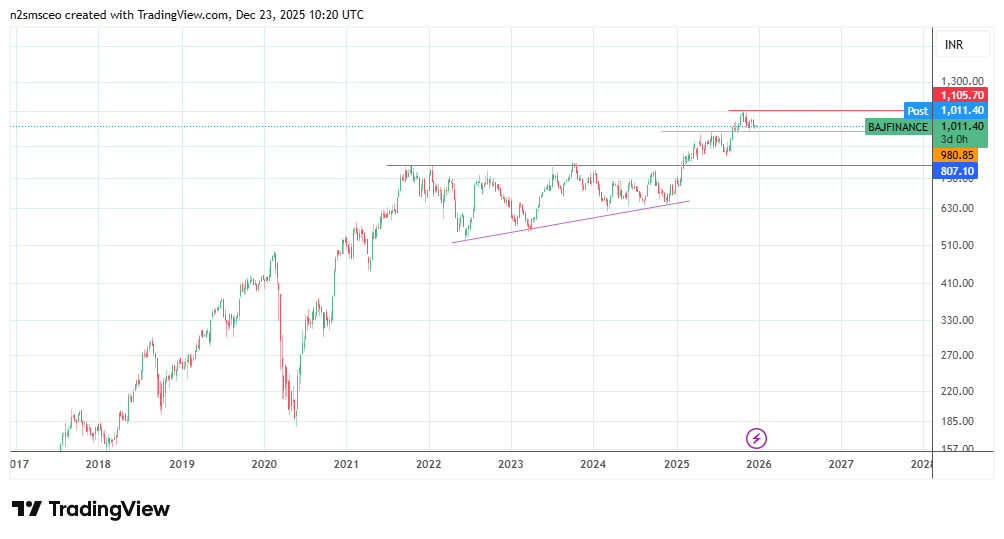
The Bajaj Finance share price today is off its all-time highs due to profit-taking which hit the Indian bourses in December. The INR 1,102.5 price mark set on October 23, 2025 is the highest the share price of Bajaj Finance has ever attained.
Bajaj Finance Share Price Target 2026
Institutional entities usually publish outlooks that are limited to a 12-month time frame. The Bajaj Finance share price targets provided in 2025 therefore fit into the profile of Bajaj Finance share price targets for 2026.
Jeffries has a Buy rating, with a target of INR 1270 by 2026. This is an implied upside of 25.6%. ICICI Securities has a Bajaj share price target 2026 of INR 1050, which is a 3.8% upside potential. JP Morgan is neutral on the stock, with a price target of INR 1040. CLSA assigned an Outperform rating, with a price target of INR 1200. UBS and Bernstein are bearish on the stock. While UBS has a Sell rating and a INR 750 price target, Bernstein’s INR 640 price target comes with a 36.7% downside bias with an Underperform rating.
Key drivers for these targets include AUM growth trajectory and forward guidance, valuation/growth durability, cost of credit and quality of assets.
Bajaj Finance Share Price Target 2030
Banks and sell-side institutions do not publish reports detailing Bajaj Finance’s share price targets for 2030. For these, we have to look at retail-focused blogs.
SharePrice-Target has the most conservative of these 2030 forecasts. Its Bajaj share price target for 2030 lies within the INR 3800-4718 price range. This forecast captures the split adjustment, which effectively increased the number of Bajaj Finance shares 10X. Coinmonks has a split-adjusted Bajaj Finance share price target of INR 1800, citing growth in credit cards and UPI payments as a major driver. FincoPanda has a share price target of INR 4097 by the end of 2030, which has accounted for the June 2025 stock split.
Other price targets provided before June 2025 did not account for the stock split, so it is not surprising to see DailyBulls predicting a price of INR 38,174 by 2030. Pricing in the tens of thousands does not account for the stock split and price markdown.
Bajaj Finance Share Price Target 2040
SharePrice-Target’s 2040 range is INR 9468 and INR 10155. This Bajaj share price target for 2040 accommodates the stock splits and accompanying increase in the number of shares. Other 2040 Bajaj Finance share price targets for 2040 are currently unavailable.
Digital Lending & MSME Growth Strategy
Bajaj Finance wants to deploy what it calls an “omnipresent” distribution model that will incorporate a shift to an AI-driven operating system, even as it positions MSMEs as its next growth frontier.
a) Digital Lending
About digital lending, Bajaj Finance aims to dominate all digital channels (AI, social, web, app, and physical) where its users are already present. In its FY2025 report, proof points indicate that there were more than 70 million net installations of the Bajaj Finserv app and more than INR 20,000 crore in personal loan disbursements. A little under 39% of service requests were made on the web and the Finserv app, totaling 7.7 million digital loan repayment receipts. Bajaj Finance is also implementing merchant-linked rails to support repeat patronage of its loan products, thereby lowering its customer acquisition costs.
Bajaj Finance is also incorporating artificial intelligence into its operations. Its FY2024-2025 report highlighted plans to deploy 75+ AI applications in the 2026 full year, spanning several AI agents, such as voice and text bots and agentic AI, to provide end-to-end automation of tasks.
As part of its distribution strategy, Bajaj Finance has entered into a partnership with Bharti Airtel to integrate its products into the Airtel store and app network, providing access to Bharti Airtel’s extensive customer base. Four products debuted in the rollout plan, with more products to be added soon.
b) MSMEs
Bajaj Finance has explicitly identified the micro, small, and medium-scale enterprises as its net growth frontier. One strategy aims to acquire and cross-sell across various SME-friendly products such as credit, payments, insurance, deposits, and investments. It also aims to provide MSMEs with access to credit by radically reducing decision times and offering flexibility in payment tenors. Its MSME distribution strategy aims to scale by being partnership-led (such as the Bharti Airtel partnership mentioned earlier) and by deploying via digital funnels, while still maintaining and deepening a “boots-on-the-ground” roadmap for its branch footprint. The latter recognizes that, for many MSMEs, digital switches may take time and that traditional outreach methods remain essential.
Impact of Stock Splits and Bonus Issues
The Bajaj Finance share stock split of June 16, 2025 is the second in recent history. The first Bajaj Finance share stock split was conducted on September 8, 2016. It was a 1:5 stock split that effectively cut the price from INR 10 per share to INR 2 per share. The 2025 split reduced the face value of the stock from INR 2 to INR 1, essentially making this a 1:2 stock split.
As the stock splits did not reduce the inherent value of the share price of Bajaj Finance, the stock traded in a sideways range for a while before breaking above the ascending triangle. This led to several bullish Bajaj Finance share price targets for 2026 and 2030.
Apart from the stock splits, there have been two bonus issues for Bajaj Finance shareholders. The first was announced on 26 July 2016, with record date of 10 September 2016. One bonus share was issued for every one share held. The second issued 4 bonus shares for every 1 share held, and was announced on April 29, 2025 with record date on June 16, 2025. This bonus issue was paired with the 205 stock split.
FAQ
Why is Bajaj Finance share price falling today?
Bajaj Finance share price is marginally higher even though volume was low. Some bargain buying after profit-taking appears to be taking place.
What is the Bajaj Finance share price target for 2030?
The most conservative estimates have the Bajaj Finance share price target for 2030 at around INR 3800.
When will the next Bajaj Finance bonus share be credited?
The next Bajaj Finance bonus share will only be issued if the board proposes to pay dividends via bonus shares issuance, and the shareholders approve it in the Annual General Meeting.
How many times has Bajaj Finance share split?
Bajaj Finance has had two share splits: in September 2016 and June 2025.

 AAPL
AAPL 
 MSFT
MSFT  META
META  ^NDX
^NDX  BTC-USD
  XRP-USD
 SUZLON.NS
  INR=X
INR=X  EURUSD=X
  JPY=X
JPY=X  CAD=X
CAD=X