

- GBPUSD is tightening around 1.32 as markets wait for clear BoE-Fed policy divergence.
- A hold above 1.30 keeps near-term bullish structure intact; Fed-rate cut expectations (85%) support upside.
- 2026 outlook leans bullish on anticipated USD weakens from deeper-than-priced Fed easing.
- UK's rising tax burden limits its long-term Sterling appreciation capacity.
Table of Contents
- Executive Summary: Strategic Overview and Primary Objectives
- Core Themes Guiding Long-Term Analysis
- GBPUSD Live Chart
- GBPUSD Market Outlook and Technical Analysis
- Fundamental Drivers & Market Trends
- Monetary Policy Divergence: BoE vs Federal Reserve
- Structural Macroeconomic Forces
- High-Impact Data Events
- Long-Term GBPUSD Forecasts
- GBPUSD Forecast 2026
- GBPUSD Forecast 2030
- GBPUSD Forecast 2040
- Frequently Asked Questions
- When is the best time to trade GBPUSD?
- Why is the GBPUSD pair often called “cable”?
- How much is one pips worth in GBPUSD trading?
Executive Summary: Strategic Overview and Primary Objectives
The following article details a complete structural analysis and probabilistic forecast for GBPUSD including near-term volatility in the form of the British pound vs. U.S dollar five-year arrogant target, based on secular macro economic trends, extending through 2040.
We are currently in market where the technical picture is great ambiguous given price is tightening up near 1.32 with institutional players not interested in pricing in any material evidence of divergence persisting between the BOE and the Fed.
The tactical outlook over the near term is choppy, but it’s very delicate towards the key 1.30 support area. The recent rebound in the pair is essentially based on high market expectation of 85% for an aggressive decision by the Federal Reserve ahead and this should benefits it’s non-dollar component of the pair.
The outlook in the medium-term to 2026 hinges on the expected US dollar weakness. This anticipated decline in the denominator of GBPUSD pair will result from predicting that the Federal Reserve will cut rates more strongly than is currently priced by broad market consensus. This is going to be the main supportive lift for the pair.
The longer-term 2030 and 2040 perspective is structurally limited by UK-specific long-haul headwinds. Indeed, the tax burden is expected to hit record 38% of GDP by 2030 to 2031. This fiscal drag is crucial headwind, restricting the amount of sterling appreciation that can be behind led by “proper”, sustainable endogenously driven means in the years to follow.
Core Themes Guiding Long-Term Analysis
- Significant USD depreciation forecasted for 2026.
- The continuing extent to which the UK’s fiscal path remains austere.
- The nature of historical support and resistance is an important cyclical turning point.
GBPUSD Live Chart
GBPUSD Market Outlook and Technical Analysis
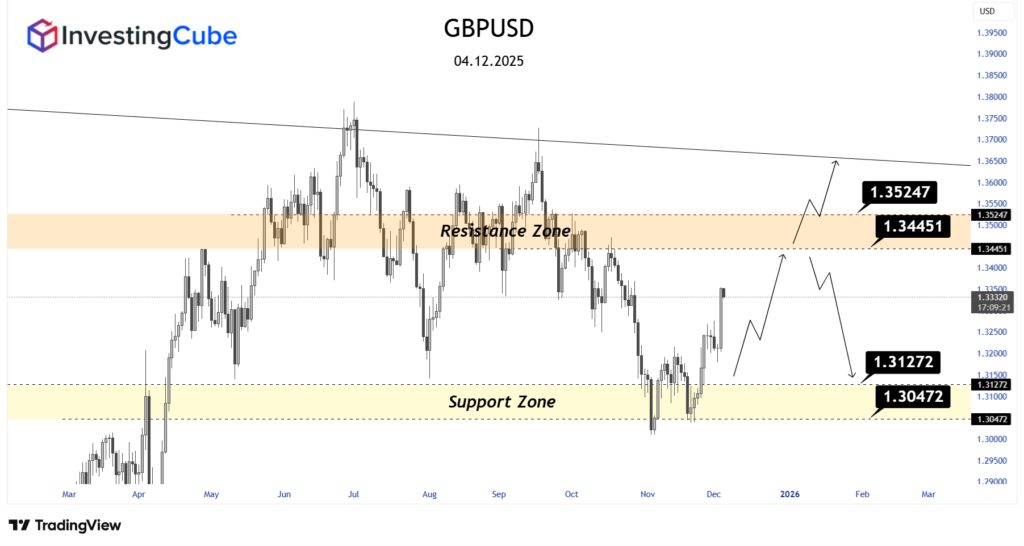
The daily chart as of December 4, 2025, shows GPPUSD extending its sharp rebound from the November low near 1.30 and now testing the mid-1.33 region keeping a clear short-term bullish bias intact. The key support structure sits between 1.3127 and the critical 1.3047 level a zone that must hold to preserve upward momentum; a move through 1.3047 could trigger a return to downside market structure development.
The next sell-side challenge awaits in the 1.3445 – 1.3524 region, a heavy consolidation throughout July to October. A convincing break above this area would validate more upside towards higher structural levels; however, if price fails to break 1.3445, we could see a retracement into the 1.3127 or even as low as the 1.3047 before a strong market direction will be established.
Fundamental Drivers & Market Trends
GBPUSD exchange rate: Last year trend-line continues to have an impact. The longer-term outlook for the GBPUSD is almost entirely define by the differing levels of economic health in the UK and the US, as well as as a relative monetary policy: Both play highly significant roles here.
Monetary Policy Divergence: BoE vs Federal Reserve
The BoE and the Fed both have benchmark rates at 4%, thus we can expect that the next significant move for this pair is going to depend on how fast and how deep each of these central banks will cut rates.
Fed Outlook (USD):
The main support for a 2026 projection is assumed USD weakness. In contrast to the strong belief in the previous two points, US growth is on track to disappoint and inflation will stay above target for a sixth year, allowing the Fed to cut rates at a bigger clip than what markets are currently pricing. This makes GBPUSD more of an anti-dollar trade, with USD weakness likely to trump anything the BOE may throw at it.
BoE Outlook (GBP):
The BoE is likely to follow suit soon, with the weak UK GDP data as its main guide. Expectations of a BOE rate reduction are capping the GBP advance, lessening any stimulus for Sterling to rise under its own steam, via interest-rate differentials.
Structural Macroeconomic Forces
UK Fiscal Drag:
By 2030 to 2031, the UK’s tax burden will hit 38% of GDP, the highest level ever. This continued fiscal drag is a significant longer-term headwind; it hampers investment and restrict sterling from achieving sustained, domestically led strength.
US Structural Risks:
Long-term USD resilience, even if the USD is likely to continue weakening in a short term as a result of the Fed easing, very high levels of US debt and continued inflation are likely to maintain long-term treasury yield and elevated levels, consistent with a deeper dollar structural declined. Current “de-dollarization” flows are primarily driven by hedging, not genuine global abandonment of the USD.
High-Impact Data Events
GBPUSD volatility spikes around:
- MPC & FOMC official meeting in minutes or monetary policy making decisions.
- Inflation and jobs numbers (US NFP and UK/US CPI).
- Fiscal announcements, specifically that UK budget, which markets see as a bigger test than regular monthly data because of its implications for a long-term growth.
Long-Term GBPUSD Forecasts
The longer-term combined technical levels with a macro forces at work in both the UK and US economies.
GBPUSD Forecast 2026
The 2026 picture is overwhelmed by the anticipated global easing cycle, with the USD as the top brass for bullish factors. GBPUSD, however, is the standout currency pair here, and should the Fed signal a more aggressively dovish bias into next year then markets expect, then GBPUSD is all set for breaking higher out of its recent consolidation.
The key risk remains the underperformance of the UK economy, which would likely require sharper easing by the BoE may offset USD weakness.

2026 Targets:
- Base Case (70%): The pair should remain above 1.30 aiming for a retest of the 1.3700 – 1.4000 area.
- Bull Case (20%): Aggressive Fed easing or bullish UK fiscal perspective pushes price to 1.4500 – 1.4800.
- Bear Case (10%): A break below 1.30 sees a return to the anchor at 1.2400.
GBPUSD Forecast 2030
By 2030, the center of gravity moves from interest-rate differentials to structural macro themes. The UK has a long-term drag from taxes on the rise towards 38% of GDP, and the US has debt and inflation risk to navigate. The cross will likely fluctuate in a wide band, by the chart below does reflect relative growth prospects and policy impact.
2030 Targets:
- Base Case (60%): Middle point stabilization around 1.24 up to the mid 1.40s; mean target 1.3500.
- Bull Case (30%): UK productivity reforms or severe US debt stress push price towards 1.5000.
- Bear Case (10%): UK stagnation or political instability breaks 1.24 towards 1.2000.
GBPUSD Forecast 2040
The 2024 timeframe is based on the view of the USD remaining reserve currency despite de-dollarization headwinds. GBPUSD will likely to continue to behave cyclically and the currency pair might once again not move back to pre-1971 equality levels. Performance will be a reflection of the ability in each country to manage debt, structural deficits, demographics, and long cycle inflation:
2040 Targets:
- Base Case (75%) : Long-term reversion in 1.3500 -1.4500.
- Bull Case (10%) : US purchasing power in decline on a precipitous scale could drive GBPUSD to 1.5884.
- Extreme Bear Case (15%) : Deterioration in UK fiscal or policy risk driving towards 1.0300.
Frequently Asked Questions
When is the best time to trade GBPUSD?
In terms of highest volatility, and which would maximize potential profit for transactional traders, this happens at the session overlap between the London and New York financial centers, the most active period is the London New York overlap. However, the London open is also high liquidity as it is the most active period of trading due to institutional traders trading it.
Why is the GBPUSD pair often called “cable”?
”Cable” is a colloquial reference to the stomacher, which has become traditional. The GBPUSD is the longest currency pairs still traded. The phrase was first coined in the 19th century, when news of the exchange rate between United States dollars and British pounds could take several transatlantic forms: cable, transfer or a bill.
How much is one pips worth in GBPUSD trading?
A pip (percentage in point) is the unit of measurement for movement in an exchange rate. For the majority of currency pairs, including GBPUSD, a pip is the fourth decimal place or 0.0001. The pip value in terms of the quote currency is fixed regardless of the base currency. In GBPUSD, since USD is the quote currency, a pip is $1 USD. 1 pip in movement of the price is equivalent to $10.00 USD. If you could move only down one pip on a standard lot size (100,000 units), you would have made $10 USD and so forth. This standardization is critical for accurate risk and profit calculation because the pip scales linearly with the trade size.

 AAPL
AAPL
 MSFT
MSFT META
META ^NDX
^NDX BTC-USD
 XRP-USD
 SUZLON.NS
 INR=X
INR=X EURUSD=X
 JPY=X
JPY=X CAD=X
CAD=X