
- 2026 outlook is neutral-to-mildly bullish, with forecasts clustering around the ¥210 region, reflecting narrowing BoE - BoJ yield spreads and limited upside momentum.
- Market sentiment remains pivotal: risk-on supports GBPJPY though carry trades, while risk-off strengthens JPY and triggers sharp reversals.
- Macroeconomic forces remain anchored in policy divergence, with BoE tightening versus BoJ ultra-loose policy sustaining the multi-year bullish bias.
Table of Contents
- GBPJPY Live Chart
- GBPJPY Technical Chart & Market Outlook
- GBPJPY Forecast 2026
- GBPJPY Forecast 2030
- GBPJPY Forecast 2040
- Market Sentiment Analysis
- Macroeconomic Factors & Trends
- Frequently Asked Questions
- Is GBPJPY a good long-term investment?
- What drives the GBPJPY exchange rate?
- Why is GBPJPY called “The Dragon”?
GBPJPY Live Chart
GBPJPY Technical Chart & Market Outlook
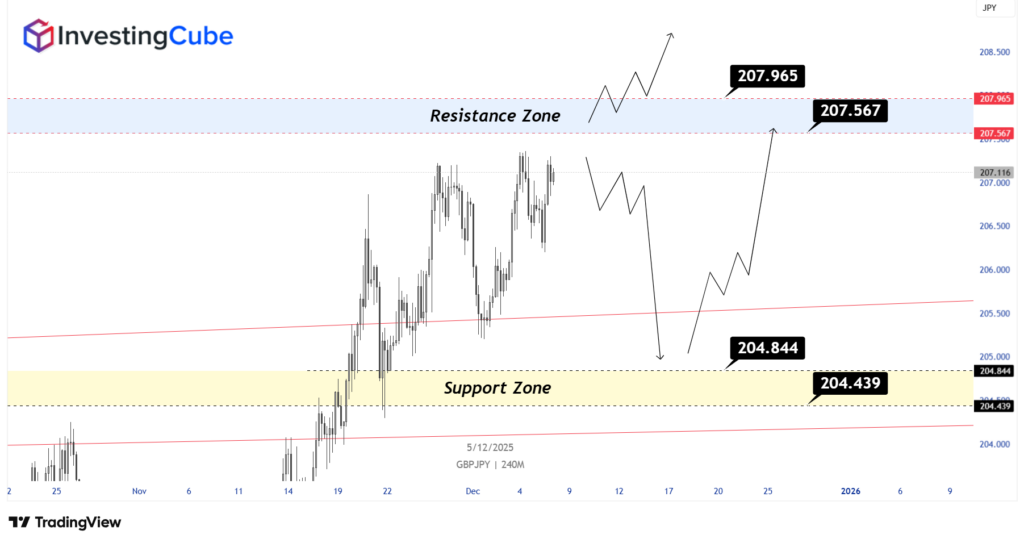
The GBPJPY pair is trading below the 207.50 – 207.96 resistance confluence, which based on another set of refusals to climb through it, suggests that there is still some selling interest near the top of the range. Price is still buoyed beneath the 204.50 – 204.85 range, a prominent demand base that merges closely with the lower side of trend structure, which continues to spark buyers’ interest.
If the support holds, the bigger picture remains positive with a breakout above 207.96 allowing for room for bullish continuation higher. Failure to clear the resistance, however, can pullback the quote to 144.80 while highlighting the 143.75 region, including support lines as downside.
GBPJPY Forecast 2026
A move towards ¥205 – ¥210 is noted in late 2025 for the GBPJPY exchange rate. Thinking forward towards 2026, a lot of experts expect at least this pair to take a less steep path up. The BoE is set to be close to its peak interest rate, and lifting the BOJ off zero may not be impossible after all.
A Reuters survey has around 96% of the economist predicting BOJ‘s rate at 0.75% by March 2026. This narrowing yield spread isn’t likely to help push GPPJPY beyond the 140 handle with a stronger yen under BOJ tightening offsetting whatever the pound has as a yield advantage.
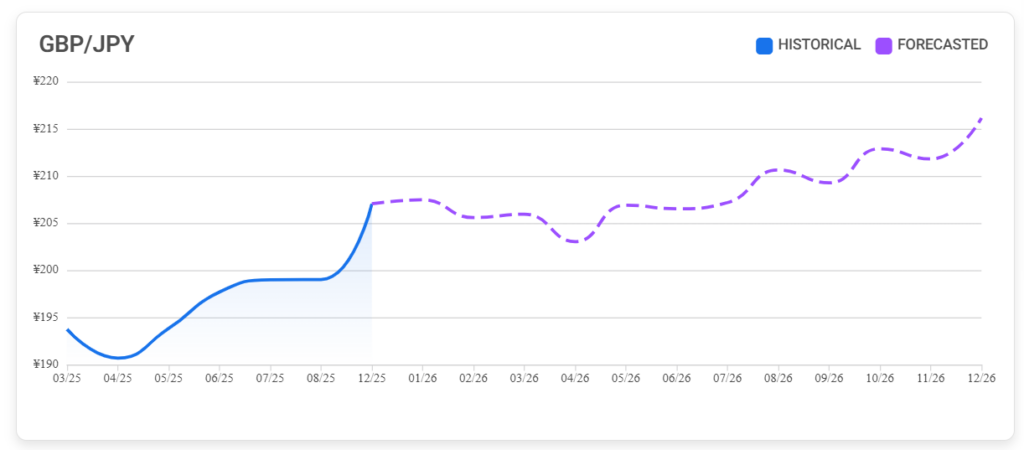
Forecast models reflect that skepticism, one or multiple of the experts are thus expecting the pairs to close roughly in the low ¥210 according to TradersUnion, not much higher than where it is now. In simpler terms, a GBPJPY forecast 2026 does not look like offering much in the way of volatile action.
From a technical perspective, key support appears near ¥200 – a downside target that, if violated, could lead to an accelerated down draft. Take note that resistance could be found around the ¥220 level if we do, in fact, get a little bit of a bounce. The 2026 view is above all neutral to mildly bullish, contingent on central bank divergence not widening further.
GBPJPY Forecast 2030
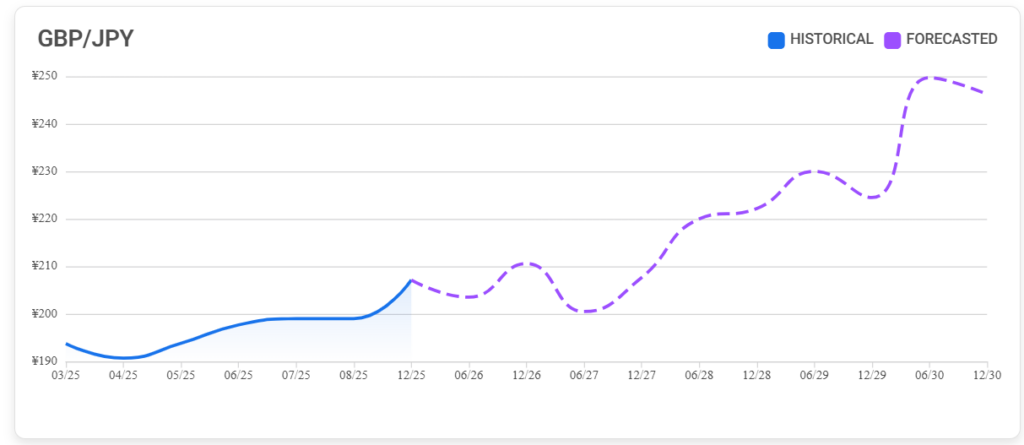
Looking further forward to 2030, the long-term picture becomes murkier. Tertiary driving factors on swing (longer time horizon) — 8 – 10 years. And in long-term falling leaves behind market volatility for GBPJPY if both macroeconomic trends and central banks directions morph by 2030.
On the one side, continued Japanese demographic problems, and a further extension of BOJ excessiveness might erode the yen even more. Some long range forecast project the GBPJPY exchange rate climbing into the mid ¥240s by 2030, according to tradersunion, indicating a sharp appreciation of the pound versus the yen in 10 years. This bullish case supposes that the Bank of England will keep interest rates relatively high, and Yuen will persist as a cheap funding currency for carry trade.
Conversely, there is a case for yen strength by 2030 if Japan ever normalize monetary policy or if shift in the global economic landscape start of favor safe havens. There is enormous variation, for example, but one of the algorithm models expects a massive GBPJPY collapse to close to ¥114 in 2030 on a rising yen value. Though it is an outlier, it illustrates the variation in potential results.
In the real world, more forecasters see a less dramatic trajectory: perhaps with GBPJPY moving little or even higher if BOJ and Bank of England policies gradually converge. As we head towards 2030, investors should be prepared for increased volatility as we approached 2030 balancing technical trends with macroeconomic signals.
GBPJPY Forecast 2040
The long-term outlook for GBPJPY is highly uncertain between now and 2030 but two models defined extremes of our future.
In scenario 1, Japan manages to break out of the deflationary spiral and BOJ normalization take place. Structural reforms and productivity gains would lie the BOJ keep rates high, eroding that carry advantage of the pound for many years.
Some Japanese politicians have said the yen is still structurally undervalued at current rates according to Reuters. Should the yen return to something in the way of fair value overtime, then GBPJPY could drift lower or stabilize — more towards historical averages than go a lot higher.
The second scenario adopts the assumption that Japan’s structural issues — and aging population, low demand and very high indebtedness by the public sector — continue for most of the 2030s. If the BOJ remains dovish and continues to put downward pressure on the yen, this pound-to-yen rise higher is likely to stay in tack. In those circumstances, with further slumping of the yen, GBPJPY could retest or rise through its 2007 peak around ¥ 250.
Overall, the GBPJPY 2040 forecast ranges from a significant long-term correction driven by yen recovery to a renewed multi-decade rally, favoring the pound investors with a very long horizon should closely monitor shifts in macro fundamentals and the evolving policy between the BoE and BoJ.
Market Sentiment Analysis
When basing a trade on the medium and long-term, market sentiment is integral to the analysis of GBPJPY. The JPY is haven, GBP does better in a risk on environment. During periods of global market optimism (risk-on), traders tend to borrow lower-yielding yen to buy higher-yielding currencies or other assets, possibly pushing the value of GBPJPY up.

On the contrary, when investors seek a haven in case of risk-off events or market turmoil, money flows back into yen and pushes down the GBPJPY. This eventuality was perhaps best illustrated by the 2008 financial collapse and more recently, Brexit p#vote shock of 2016 that saw heavy inter-market flows into the currency from those looking to hedge risk while uncertainty surged, sending GPPJPY plummeting down to fresh lows.
Currently, sentiment indicators suggest traders are laser-focused on central bank signals and global growth data. The rise in yen demand could result in the “dragon back down” as volatility spikes or equities collapse. Conversely, a steadier or brighter outlook for the world favor sterling. To put it altogether, when the market is optimistic and desires risk, GBPJPY will tend to rise as well, while fear and uncertainty can drive in some particularly sharp GBPJPY drops as traders shed currency for safe havens like the yen.
Macroeconomic Factors & Trends
The long-term GBPJPY behavior is much better explained by policy divergence between the BoE and BoJ. The BoE has hiked rates to combat inflation, but the BoJ has held the near-zero rates for ages (capital.com). Japan policy rate has generally fallen between 0.5% and 0.1% since the early 2000s (FXCM), so there stands a consistent yield gap conducive to yen-funded carry trades.
It is also the inflation and growth differentials that shape this pair. The UK is more pronounced inflation that compares with Japan’s aging population and tiny price pressures. By acting as a net importer of energy, Japan’s currency has also been depreciate relative to alternative currencies while oil spikes (FXCM). And what about outward balances: Japan’s current account surplus can underpin JPY while UK sentiment remains in the grip of post-Brexit jitters.
In the big picture, structural long-term bearish and unfolding conditions that continue to favor policy diverging BoE-BoJ forces driving the multi-year GBPJPY.
Frequently Asked Questions
Is GBPJPY a good long-term investment?
GBPJPY is one of the only major pairs to make up a long-term strategy; however, it is also one of the most volatile. It’s attractiveness has stemmed largely from the difference in interest-rates levels, with UK yields historically outstripping Japan’s and providing long-term carry returns, but the two extremes in this pair mean that drawdowns can be vicious. In the 2008 crisis, GBPJPY fell from about ¥250 to close to ¥120, highlighting how fast conditions can reverse. It could be appropriate for investors who expect the pound to remain strong, but risk management should be tight.
What drives the GBPJPY exchange rate?
The GBPJPY pair tends to be driven by interest rate differentials between the Bank of England and the Bank of Japan, oscillating in wider ranges when the spread between the two widen. Market risk sentiment is also a major driver: the yen gaining times of stress and risk version, but GBPJPY has been especially sensitive to volatility. Other economic disparities may play a role in longer-term trends, including Britain’s relatively higher in inflation, compared with Japan’s lasting weak price pressures. Japan’s reliance on imported energy makes spikes in oil prices a drag on the yen. These are the big picture factors that influence the pair’s longer-term direction.
Why is GBPJPY called “The Dragon”?
GBPJPY is known as”The Dragon” in Forex due to its penchant for ranging widely, giving the pair some unique characteristics compared to other major pairs. It’s volatility is further magnified by policy divergence, changes in risk mood and carry flow, which may trigger rapid 200 to 300 pip moves. The name indicates that not only it is designed to trade one of the most high-risk currencies, but also allows trading with greater risk to reward, compared to its counterpart within said currency pairs.

 AAPL
AAPL
 MSFT
MSFT META
META ^NDX
^NDX BTC-USD
 XRP-USD
 SUZLON.NS
 INR=X
INR=X EURUSD=X
 JPY=X
JPY=X CAD=X
CAD=X