

- The Fed's move to cut interest rates by 25 basis points in succession towards the end of 2025 has tamed the dollar's strength
- The BoE also cut rates towards the end of 2025 but its tone is more hawkish amid sticky inflation
- US military action in Venezuela has not impacted forex markets as previously feared
Table of Contents
- The BoE and the Fed Pulling In Different Directions?
- Is the GBP/USD Rise Sustainable?
- The Venezuela Factor in Forex Markets
- GBP/USD Forecast
- Why has the pound been rising against the US dollar since late 2025?
- Will the Bank of England match the Fed’s rate cuts in 2026?
- What is Venezuela’s impact on GBP/USD?
The British Pound’s recent ascent against the US dollar, a trend that took firm root around November 20th, 2025, has left many market observers wondering if the GBP/USD pair has finally found a permanent home above the 1.3500 level. While the rally has been impressive, the narrative behind it has less to do with a booming British economy and more to do with a softening greenback.
The BoE and the Fed Pulling In Different Directions?
The main reason for this shift is that the UK and the US central banks are expected to handle their money policies differently in 2026. Data from LSEG and Office for National Statistics shows that while the UK is struggling with inflation stuck at about 3.1%, the US has seen its Core PCE Inflation drop faster to around 2.8%. As a result, the Federal Reserve has appeared to be more aggressive.
Since September 2025, the Fed has cut interest rates three times by 0.25%, bringing their main rate to between 3.5% and 3.75%. On the other hand, the Bank of England (BoE), led by Governor Andrew Bailey, cut rates by 0.25% in December to 3.75%, but they’re still sounding more cautious than the Fed. This means that yields are higher in the UK, which is tilting the scales towards the pound.
Is the GBP/USD Rise Sustainable?
Many investors are wondering what the BoE and the Fed are planning for the rest of the year. Most analysts, including those at Morgan Stanley, expect the Fed to continue its easing cycle, potentially pausing only when rates hit the 3.0%-3.25% mark by mid-2026. Goldman Sachs projects the Fed will cut rates twice in 2026, aiming for 3-3.25%. J.P. Morgan Predicts the GBPUSD rate going up to 1.39% in early 2026, suggesting that gains will be limited as the USD gets stronger.
The BoE, meanwhile, is likely to be a slow mover. Market pricing suggests perhaps two more cuts in 2026, targeting a terminal rate of 3.35%. If UK inflation remains stubborn, the pound may continue to outperform, but the “bull run” is becoming increasingly dependent on the US dollar’s weakness rather than the UK’s own 1.2% growth forecast.
The Venezuela Factor in Forex Markets
Recent events in Venezuela are adding new factors to consider. Right now, it doesn’t seem like US actions to remove Nicholas Maduro will greatly change the forex market outlook for 2026, but they do create uncertainty. Oil prices have gone down since the operation, which could put pressure on currencies tied to commodities but could indirectly help the GBP/USD if the USD sees less safe haven demand.
GBP/USD Forecast
The GBP/USD pair is currently showing signs of stabilizing around 1.3550. On the daily chart, the pair is above its 20, 50, 100 and 200-day Simple Moving Average (SMA) a strong sign that it will likely continue going up.
Also, the RSI is around 67, suggesting there’s still room for gains before it becomes overbought. The next resistance is at 1.3570, and if GBP/USD goes above that, it will target 1.3600. If it manages to flip that into a support, it could create a platform to rise to 1.4000.
On the downside, key support is at 1.3478, below which the upside narrative will be invalid. The second support will likely be at 1.3430.

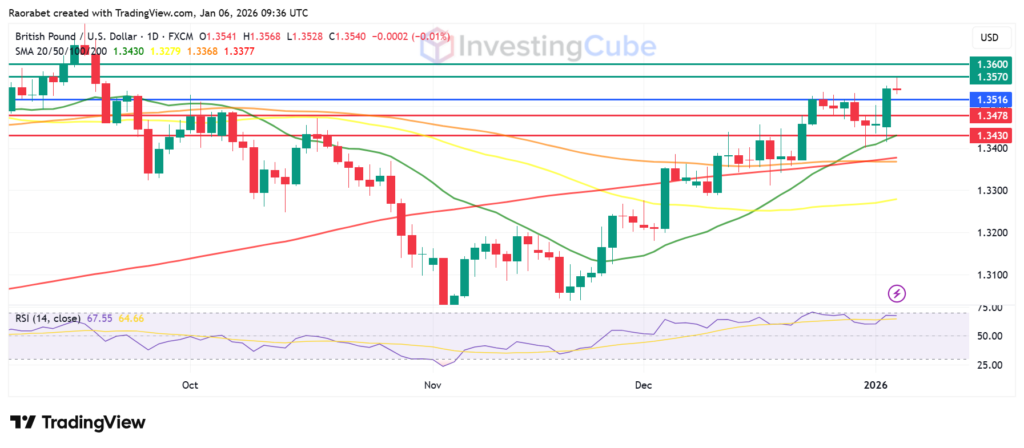
GBP/USD daily chart with key support and resistance levels on January 6,2026 created on TradingView
Why has the pound been rising against the US dollar since late 2025?
The rise was primarily driven by a dovish Federal Reserve cutting interest rates three times in succession starting September. Meanwhile, the Bank of England remained cautious due to stubborn UK inflation, creating a favourable interest rate differential for the pound.
Will the Bank of England match the Fed’s rate cuts in 2026?
That is unlikely as the BoE is expected to move more slowly with only two 25 basis points cuts projected for the year as they balance modest GDP growth against inflation that remains above their 2% target.
What is Venezuela’s impact on GBP/USD?
The recent US military action in Venezuela introduce uncertainty but are unlikely to significantly alter the outlook, potentially boosting USD in the short-term.

 AAPL
AAPL
 MSFT
MSFT
 META
META ^NDX
^NDX BTC-USD
 XRP-USD
 SUZLON.NS
 INR=X
INR=X EURUSD=X
 JPY=X
JPY=X CAD=X
CAD=X