

- Explore the comprehensive Paytm Share Price Target analysis for 2026, 2030, and 2040. Get expert insights on financial performance, growth trends and long-term investment potential
Table of Contents
- Live Chart
- Paytm Share Price Target 2026
- Paytm Share Price Target 2030
- Paytm Share Price Target 2040
- Technical Analysis & Market Sentiment
- Why is Paytm Share Price Fluctuating?
- FAQs
- What is the Paytm share price target for 2025?
- Why has the Paytm share price been falling recently?
- Is Paytm a good stock for long term investment by 2030?
- When is the Paytm share price expected to recover?
Paytm, listed as One 97 Communications on the NSE, has moved from a high growth fintech story to a regulatory stress test case. For investors tracking the Paytm share price target, the key question now is whether the post crackdown reset creates a healthier, more compliant business, or caps long term upside.
Recent directives by the Reserve Bank of India (RBI) against Paytm Payments Bank, followed by a transition to a third-party UPI model, have forced the market to rethink revenue and valuation assumptions. At the same time, India’s digital payments volumes keeps hitting new records, which still supports a structural growth story for well-positioned platforms.
Live Chart
The current share price of Paytm reflects this tug of war between regulatory damage and digital payments tailwinds. After the 2024 RBI order that stopped fresh deposits and top ups at Paytm Payments Bank from mid-March, the stock saw heavy selling as investors priced a sharp hit to margin payments and wallet flows.
On most live feeds tracking Paytm share price NSE, like one below’s daily swings remain wide. Sentiment tends to react quickly to any news around licensing, partnerships with large banks, or commentary from the regulator.
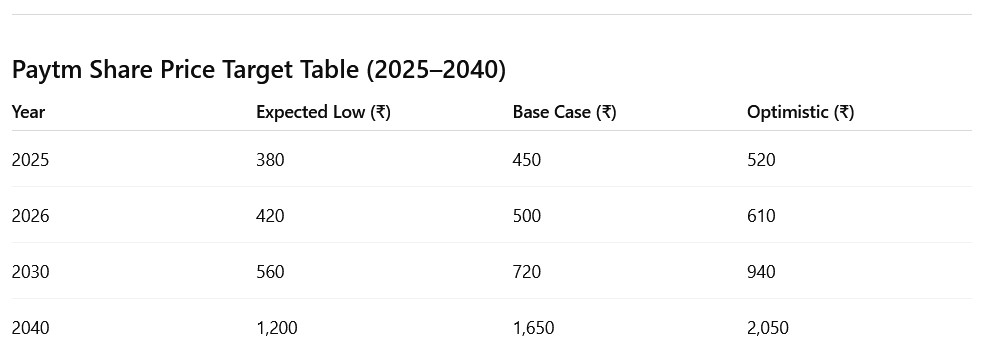
These ranges combined current broker commentary with assumptions about revenue growth, margins, and the pace of regulatory normalization. They are scenario based views, not guarantees.
Paytm Share Price Target 2026
Broker research gives a good starting point for thinking about the Paytm share price target 2025 and 2026. After the RBI action, Macquarie cut its 12 month target price to around ₹275 and flagged a potential 60 to 65 percent drop in FY25 revenues from payments and distribution, highlighting the scale of the near term shock.
Management guidance and recent results tell a different side of the story. In its Q2 FY26 earnings release, Paytm reported 63 percent year on year growth in distribution of financial services revenue, driven mainly by merchant loan distribution and better collections for partner NBFCs. If this trend continues and payments stabilise under the new bank partnerships, a reasonable Paytm share price target for 2026 sits in the ₹500 to ₹610 band, with downside risk toward ₹420 if revenue normalisation is slower than expected.
Paytm Share Price Target 2030
For 2030, the Paytm share price prediction is more about the shape of India’s fintech landscape than one quarter of earnings. NPCI data shows UPI volumes and value hitting new highs in 2024 and 2025, underscoring how deeply digital payments are embedded into day to day transactions.
Jefferies, in a 2025 note, kept a positive stance on Paytm, projecting around 24 percent revenue CAGR between FY25 and FY28 and potential EBITDA margins near 15 percent by FY28, helped by growth in financial services and operating leverage. If those margin and growth assumptions hold, Paytm share price target 2030 in a base case clusters around ₹720, with a reasonable range between ₹560 and ₹940, depending on execution and regulatory stability.
Paytm Share Price Target 2040
By 2040, the story shifts almost entirely to long term digital adoption and credit penetration. Government and industry data already show UPI handling tens of billions of transactions monthly and becoming core infrastructure for households and small businesses.
If Paytm maintains a strong merchant base, scales its device subscriptions and continues to act as a distribution partner for loans, insurance and investments, a Paytm share price target 2040 in the ₹1,200 to ₹2,050 band is plausible. This assumes steady compounding in earnings, tighter risk management and a mature regulatory relationship.
Looking far beyond, very long term scenario work can put 2050 valuations in the ₹2,400 to ₹4,100 zone, but those projections are more sensitive to policy, competition and technology shifts.
Technical Analysis & Market Sentiment
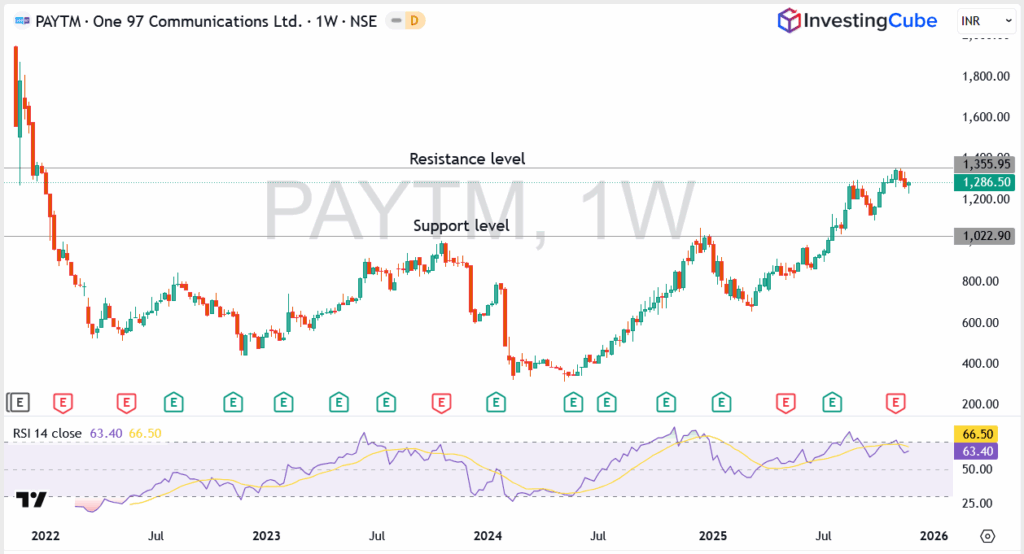
From a chart perspective, the Paytm share price chart shows a long base forming after the sharp post-RBI selloff. Price has attempted several times to build suppot near prior lows, with accumulation volume appearing on select up days.
Short term traders watch the 200-day moving average on Paytm as a key pivot. Closing back above that line with rising volume would be an early technical signal that the market is starting to look beyond the regulatory shock and focus again on earnings growth.

Why is Paytm Share Price Fluctuating?
There are clear reasons why the Paytm share price today live remains volatile:
- RBI’s restrictions on Paytm Payments Bank changed the economics of its payments and wallet business almost overnight.
- Broker downgrades, including Macquarie’s sharp target cut, reset expectations on revenue and profitability.
- Ongoing regulatory and enforcement scrutiny, including foreign exchange compliance questions, keeps a risk premium on the stock.
- Global investors have rotated from growth at all costs to profitability and cash flow, which hurts high multiple fintech names.
At the same time, the structural growth of UPI and digital payments provides a supportive backdrop for any platform that can navigate compliance issues and sustain Q on Q revenue growth.
Also read our Rivian Stock Price Prediction here.
FAQs
What is the Paytm share price target for 2025?
The Paytm share price target 2025 in this framework sits between ₹380 and ₹520, with the lower end reflecting prolonged regulatory overhang and the upper end assuming faster stabilization of payments and financial services revenues.
Why has the Paytm share price been falling recently?
Most of the recent weakness is tied to RBI restrictions on Paytm Payments Bank, follow up regulatory scrutiny and broker downgrades that factor in revenue cuts and higher risk.
Is Paytm a good stock for long term investment by 2030?
Paytm can be a long term candidate if it delivers consistent quarter on quarter revenue growth , improves profitability towards mid teens margins, and maintains its merchant ecosystem, in line with some broker scenarios.
When is the Paytm share price expected to recover?
Sustained recovery is more likely once the company posts several quarters of stable or rising revenue, demonstrates that new bank partnerships are working smoothly and shows clearer progress on regulatory compliance.

 AAPL
AAPL
 MSFT
MSFT META
META ^NDX
^NDX BTC-USD
 XRP-USD
 SUZLON.NS
 INR=X
INR=X
 EURUSD=X
 JPY=X
JPY=X CAD=X
CAD=X